Sunday, February 28, 2010

Here Today...

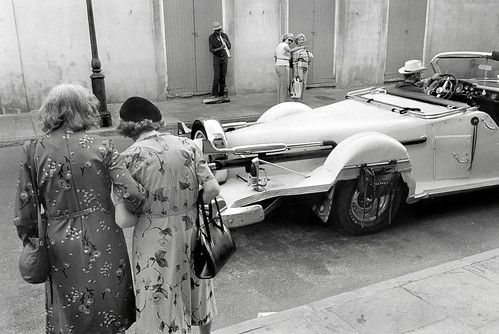
2009_056_004
A recent job working with a museum to design a digital asset management work flow while, at the same time trying to get my own hopeless, inconsistently stored mess of scans and digital captures under control rubbed my nose in the impending digital disaster awaiting me and every other amateur photographer. Institutions - museums, libraries, archives - are beginning to get digital preservation under control, carefully planing the migration of files from format to format, medium to medium. But most non-professionals haven't given it a moment's thought.

Even for those in the know, "beginning" is the key word and planning for the preservation of digital media is by far the exception. It's not only that it takes a lot of planning and investment: it's that the core concept, that digital obsolescence is far more insidious than the gradual degradation of physical materials, is very hard for us to grasp. Our technology is moving way ahead of our awareness of the profound changes that are happening. Nothing that we shoot with our beautiful digital machines will last more than the span of our own lifetimes without eternal vigilance. Somehow, the fact that this has already happened to audio and video recording hasn't changed our blithe indifference to what moving from a visible image to a digital representation means for our grandchildren's ability to see what their parents looked like as kids. The irony of our ability to shoot insanely huge numbers of images is that an even tinier proportion of those will survive into the future than what we shot on film.

While I'm confident that my friends at the National Gallery or the Art Institute of Chicago will manage their archive for many generations to come, I doubt my own digital work will last any longer than the care and attention that I can personally devote to it. Maybe I'm unusual in this regard, but I haven't actually printed more than a tiny handful of photographs in the past 15 years. In the past 5 years I haven't printed a thing. Well over half of what I've shot is on film, and as scary as it is knowing that my negatives are unique and would be irretrievably lost if we had a fire (or would be gone already if I had kept them in my ground-floor darkroom in New Orleans), it seems to me much easier to guard against fire or grab the binders in advance of an impending flood than to remember that I really have to run integrity checks on my DVD's every once in a while and remember to convert all of those early Raw files to dng. I just can't seem to ever feel comfortable with the incorporeal nature of a computer file as the sole representation of an image I really like and am vain enough to think will be liked by others even after I'm gone.

Most families treasure their photographs above all else. Time and again, it's the piles of pictures and the photo albums (and video tapes) that people grab when fleeing a disaster, not the silver or the china. But what's a photo album now? It's not the default archive that physical albums (and for most of us, shoeboxes filled with drugstore photo envelopes) used to be. The original albums were primarily designed to share images, but ultimately took on that archival function. But now we've specialized - we've teased out the sharing function from the photo album and assigned it to Facebook or Flickr, while not noticing that the archival function isn't there. We now trust the most sentimental talismans of our lives to corporations with the life spans of fruit flies. Or optical media that will disintegrate within a decade or become unreadable. I'm sure people still make plenty of prints, but I'll bet anything that the absolute number of photographic prints made will soon begin to diminish, despite the logarithmic increase in the number of pictures actually taken.

Monday, February 15, 2010

Gary has left the building


Is this new? Flickr (my constant obsession) is peppered with tribute groups of various sorts, among them some devoted to the work of famous photographers. These are hard to pin down using Flickr's group search facilities, so those that I've encountered are what I've stumbled into while riding my own particular hobby horses. You can search for individual names and find the groups that mention a specific photographer in their descriptions, but that doesn't necessarily make them "tribute" groups. Still... a little concerted effort by searching on the names of various famous photographers (famous to ME anyway, so maybe we're actually talking about photographers who were famous about a decade ago) pulled up these results, presented in order of apparent popularity with the number of groups in which they are cited:

Cartier Bresson - 104
Ansel Adams - 89
Robert Frank - 80
William Eggleston - 44
Gary Winogrand - 32
Walker Evans - 29
Diane Arbus - 28
Martin Parr - 19
Elliot Erwitt - 10
Lee Friedlander - 8
Sally Mann - 5
Edward Burtynski - 3

In all of these cases the majority of the groups appear to be devoted to some style of which one of these photographers, typically along with a number of others, is an exemplar. But for all the photographers named above there are groups specifically devoted to pictures that are "influenced" by them. While I have my share of pictures in a number of these groups, it's more a matter of seeing something in my work that fits the promoted style. (In other words, I'm spamming them in a pathetic attempt to get people to look at my pictures.) But clearly there are people who walk around trying to take Winogrand or Friedlander or Eggleston pictures, and I'm really both intrigued and put-off by it. From a description for a Sally Mann group:

A tribute to one of the greats who defined not only a style of photography but a mood. Her haunting portraits of children and young people do not feel like photographs, but it is as if you are seeing what is in a child's heart and mind. As if they are looking to you and showing you their angst, love, maturity, and spirit.

and then the kicker:

Color accepted. Black and white preferred. (as, evidently, children prefer to emote in black and white).

In fairness, some of these groups take an interesting pedagogical/critical approach, attempting to deconstruct the style of their namesake in order to make better sense of it. (Didn't I do this kind of thing with my friends in bars back in the 70's? I honestly can't remember whether I tried to emulate Winogrand or just got depressed at the futility of trying.) And at their best, the members of these groups produce fascinating anecdotes, rarely seen images, and mini-essays that can be surprisingly lucid and informative. Of course, at other times they're just parochial (see above vis. color vs. B&W).

In the end, this seems related to a broader cultural phenomenon: the leveling of technological barriers to the appreciation of historical works of art that are, themselves dependent on technology. It's easy to appreciate musical recordings from about 1955 on. Not so easy for music recorded earlier than that. It's easy for younger generations to appreciate films made after the use of color became routine. It's not just that technology like the web makes things more accessible as in Easier to Find, but that at some point, for many media, a threshold was passed where it became unnecessary to make an effort to see or hear past an obtrusive technological barrier -- the rendering became "good enough" to appreciate the work on its own merits and within the context of the culture that produced it, however long ago.

Or did it? Now that everything in "film" is CGI, and anybody with a PC or Mac can multi-track any number of instruments, which themselves can be synthesized pretty convincingly, will REAL film start seeming as alien and imperfect as work produced on the other side of the technical threshold?

Sheesh. What the HELL am I talking about?

Sunday, February 15, 2009

Discontented Winter

today and last month
After going for more than 20 years without really experiencing a full winter season (and my Wisconsin based siblings would argue that Maryland doesn't really qualify as a winter season state)I have a hard time getting used to the days without light and the blustering winds that make walking the street with a camera less enticing than it is even in the sultriest days of summer.

As if I needed reminders, my lack of discipline during the past three months (both in my pursuit of photography and in the occupation that pays at least a few of the bills around here)has made it clear to me in so many ways that I am not a photographer. Five years ago, when I picked up my camera again, it was enough to produce numbers: if I could shoot one roll of film a week, or two, or perhaps three, I would at least have something to choose from. Now roughly 20,000 exposures later (and although that number is laughably tiny for most "serious" photographers, it's considerably higher than my pre-parenthood-hiatus average) I know that I need to concentrate much more on content and technique and I doubt I have the patience, focus and time to do it. So far it has been enough to live with a kind of diaristic narrative approach. But even in this respect, what I do is not even that. For the most part I continue to ape the work of photographers I admire and feel disheartened by the gulf between my work and theirs.

Wednesday, January 21, 2009

Taking it Easy

2006_078_08

There are certain pictures you take that you know will be readily accepted, even applauded. They fall into existing genres or implement tropes that are recognized and appreciated by a large group of people. They vary in sophistication from the banal to the esoteric; from the blandest sunset to a deft channeling of Gary Winogrand. I see these all the time and shoot them and show them with concurrent feelings of guilt and frustration. Guilt, because this was low-hanging fruit that I recognized and knew would appeal to someone who would give me an attaboy. And frustration because I would rather hear good stuff about interesting failures. The best that you can say about the easy shots is that you executed well. As in the above, which I knew would be liked because it's a pretty good silhouetted guy with an umbrella walking picture. I don't know how many of these there are out there, but I feel as if I've seen this image a whole lot of times. I do think I did it well, but it's still only another dog on the pile. I'm not good enough to wander off the trail and come back with fresh meat that often, so when I try it would be nice to find out if it's tasty. This one:

R2008_11_167

is much more of a mess. I know there's something wrong with it, but even as a failure, it seems far more interesting to me than umbrella man. But posted on Flickr, where some of my contacts are really sharp, it still didn't get a second look. Is it me or is it Clairol?

Saturday, November 22, 2008

Geography as Hubris

1985_047_04
When I started shooting again after 15 years or so of pretending that I didn't have time, it was an addictive surprise to find that people (those on Flickr anyway) responded positively, not just to my old pictures, which were edited out of many thousands taken over many years, but to my newest stuff as well. It wasn't until I moved to Baltimore last year that I began to suspect that my success was due as much to where I had lived as to how much talent (if any)I had. After New Orleans other places can seem a little colorless and the unhappy truth is that I can see that in my pictures. Maybe it's a symbiosis that grew over time and in a way that I really never felt happening, but for whatever reason I seem to have done a lot of my best work in that city and I haven't yet found a way to get it going in the mid-Atlantic. Maybe I'll end up putting the camera away again, this time with only the excuse of a career change to fall back on. But if I do, I doubt I'll be able to start up again in 15 years when I've finally absorbed whatever it is that works for me in Baltimore and DC.

Saturday, November 8, 2008

Heros and slobs

2007_057_04
There are those who dichotomize and those who don't. I like to. For a long time it's seemed to me that there are two basic schools in photography (just the "art" of photography, maybe all of art -- who knows -- don't confuse me, dichotomies have to be simple): small, simple and often sloppy vs. big, heroic, operatic. When I learned the craft it seemed that the most interesting work was done by the first group: Cartier-Bresson, famous for overexposing and underexposing and basically not giving a git about the technology so long as he got the image; Robert Frank, who outraged many critics in the 50's for his harsh grainy "sloppy" technique as much as for his dystopian vision; Gary Winogrand, who shot so much that visiting his own work must have made him feel as if he were exploring the archives of an unknown photographer. The primary venue for photography was publication, although that had long been on the wane, but gallery shows were few, photography majors in the art schools were few and most photographers were poor, shot black and white and didn't/couldn't make/afford huge prints.

In the 1970's this started to change and by the mid-80's the dominant forces in the art of photography were the galleries and the art schools. Galleries like things that are impressive on the walls, and art schools like to have something to teach. Unfortunately, you can't teach someone to be a Winogrand or an Arbus or a Friedlander -- where talent like that exists, it emerges gradually over time - usually more time than it takes to earn an MFA - and the level of craft needed to make that kind of work can be picked up in a one semester photojournalism class. Moreover, while that stuff looked great on the printed page and lent itself to essays, it was too intimate for Really Impressive Gallery exhibitions. As art school photography programs really got going, the aesthetic drift seemed to veer more and more toward the craft, and hence the physical object, than the image depicted on it.

While some really great photographers emerged during this period, the results of this sea change were usually (from where I sat, anyway) depressing. Novelty (excuse me, "innovation") became the most important characteristic of one's work. More often the innovation was technical or studio oriented. Photographers reinvented old technologies, used odd cameras, dressed models in curious things in odd places, made books, mounted images on weird substrates. Everything began to seem more important than the image and it was only by separating the image from the photographic object, or making it smaller, that the vacuity of a lot of these images became apparent.

To be sure things got better in the 90's when social content started leeching back into the practice, but the heroic school remains dominant in the art world. Shore, Meyerowitz, Nixon, Stein -- all still around doing great stuff. New folks like Brian Ulrich, Alex Soth and even newer folks like Amy Stein, are doing really wonderful stuff and even crossing back into journalism in some cases. But the gallery predominates. No self-respecting art photographer would shoot in smaller than medium format and wouldn't go digital unless they could use something way beyond the reach of the average citizen. The stuff looks fabulous on the wall (the recent Richard Misrach exhibition at the National Gallery is mind- bogglingly beautiful), and is almost impossible for someone not steeped in the craft to pull off.

But if, for a moment, we take the image off the wall and look at it as a non-physical artifact; if we shrink it, print it in a magazine, post it on the Web, the game changes again. Negative size won't buy you anything at 800 by 1200 pixels. Will a growing interest in social issues and mass distribution push the aesthetic back toward the small and simple? Will everything just descend into cheap effects -- a visual equivalent of top-40 with big hooks and no continuity or sense of being part of a body of work? I don't know, but it's an interesting thought. If the non-corporeal image viewed in small format (a book; a screen) is what you care about, then there's a stunning amount of great photography out there and no one in particular in a great position to capitalize on it, including the photographers.

So one thing I know is that I'm a troglodyte. I missed about 15 years of shooting while raising kids and creating a non-photographic career in a non-digital age. My knowledge of current work is hopelessly dated, so my dichotomy is probably easy to shoot full of holes.

Monday, September 1, 2008

What I'm doing or How Flickr Destroyed my Life

rally
I've been obsessive about photography for a large percentage of my life. With two interruptions, one in my teens that lasted for about four years and a much longer stretch from about 1989 to 2004, I have been a "serious" photographer since the age of 10. When I started college my parents helped me build a darkroom in the family laundry, my father gave me carte-blanches use of his newly acquired SLR and I went to town.

The main thing is that it turns out no matter how much I did (and do) this for love, it becomes hard without acknowledgment. I'm clearly not one of those people with enough self-confidence to carry on in total obscurity. And worse, it turns out I crave attention This is where Flickr became my undoing, because much to my astonishment, the ancient prints that I scanned and uploaded in late 2004 got seen and commented upon favorably by many more people than had ever seen them before. It was addictive. I wanted to read that good stuff all the time. I uploaded more pictures and began taking them again and soon, it became almost the only thing I really cared about. The absurdity of a middle aged guy with a professional career checking his Flickr site repeatedly each day to see if anyone has "faved" a shot or commented on it is a source of constant embarrassment. How can I be so freaking immature? Why is this so important to me?

Since moving to another city and trying to get established in a new work situation, it's only gotten worse. I don't have time to shoot and barely time to scan or upload pictures. I haven't uploaded a picture in a month and nothing this year has been very good, yet still, every day I check the site at least 20 times to see if someone has left a comment or put a little star on one of my shots. Pathetic. I really need to get a life.